The Creation
Genesis 1:1–2:3
Read the creation account and compare how ancient civilizations described their beginnings.

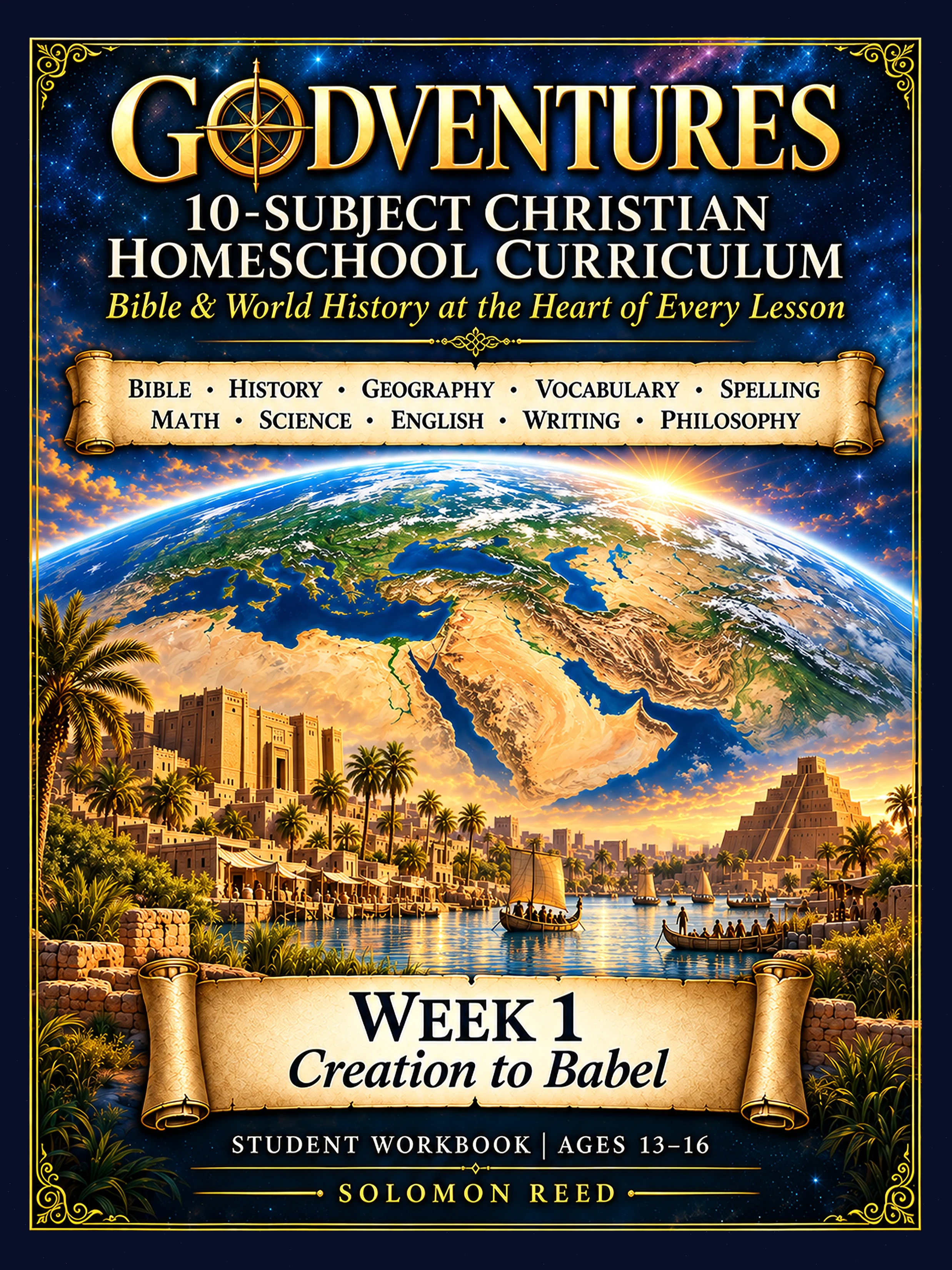
Cover artwork preview. Final cover layout may vary by edition.
Five days. Ten subjects. One connected story. This student workbook begins with Genesis 1–11 and builds each day’s lessons around a biblical event—from Creation and the Fall to Cain and Abel, Noah and the Flood, and Babel.
This is a student workbook, with lesson readings, practice and space to write. The parent/teacher answer key is a separate publication. All three print editions are planned; Amazon purchase links will appear after the listings are confirmed.
Each day includes the ten subjects in the same order: Bible, History, Geography, Vocabulary, Spelling, Math, Science, English, Writing and Philosophy.
Genesis 1:1–2:3
Read the creation account and compare how ancient civilizations described their beginnings.
Genesis 2:4–3:24
Explore judgment, mercy, responsibility and the geography connected with Eden.
Genesis 4:1–26
Consider choices, consequences and the beginnings of cities, culture and technology.
Genesis 6:1–9:17
Connect the Flood account with historical comparisons, map work and mathematical measurement.
Genesis 10:1–11:32
Examine language, human ambition and the relationship between peoples and places.
Teaching and practice share the same book, with space to work through ideas and show what you understand.
Daily readings, Scripture study, comparison charts, vocabulary, writing prompts and questions for thoughtful discussion.
Pre-algebra instruction, worked examples, guided practice, word problems and space to show calculations.
Study the labeled reference map, then label, trace and work on the matching student activity map.
Advanced Enrichment adds interpretation, evidence and reasoning. Ages 15–16 complete it in at least three parent-selected subjects each day.
Parent and teacher answer keys are separate companion publications. Explore the grading support →
Day 4 starts with the Flood in Genesis 6–9. From that one account, students move through biblical reading, historical comparison, map work, measurement and reasoned argument.
Genesis 6:1–9:17 · The shared starting point
Read the biblical account and identify its details and covenant promises.
Compare Genesis with Sumerian and Babylonian flood accounts.
Study the mountains of Ararat and the regions behind the flood traditions.
Use area, volume and geometric reasoning with dimensions connected to the ark.
Explore engineering questions and evaluate moral and philosophical arguments.
Examples are drawn from the Week 1 workbook. The full day continues through all ten subjects.
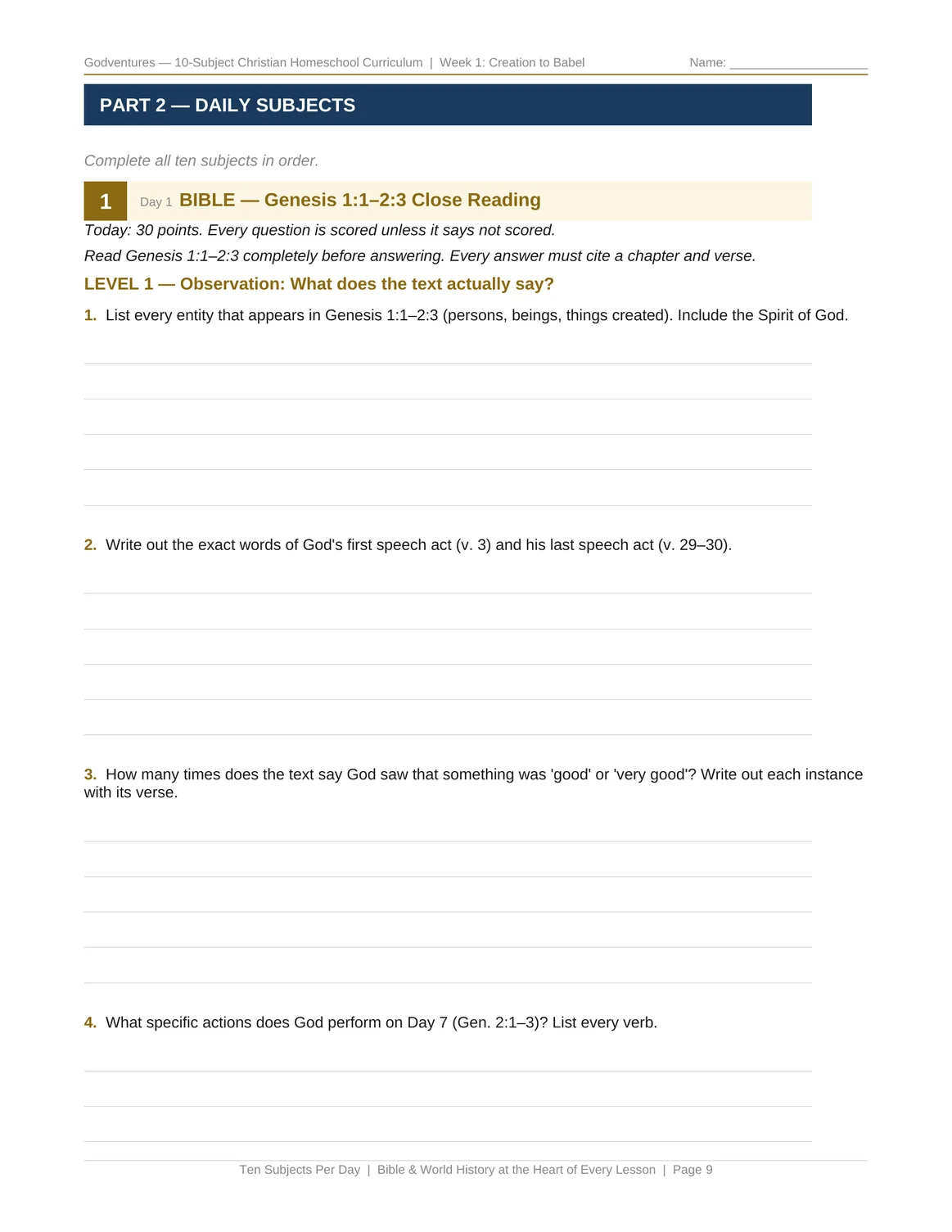
Read Genesis closely, cite verses and write thoughtful answers.
Read this sample →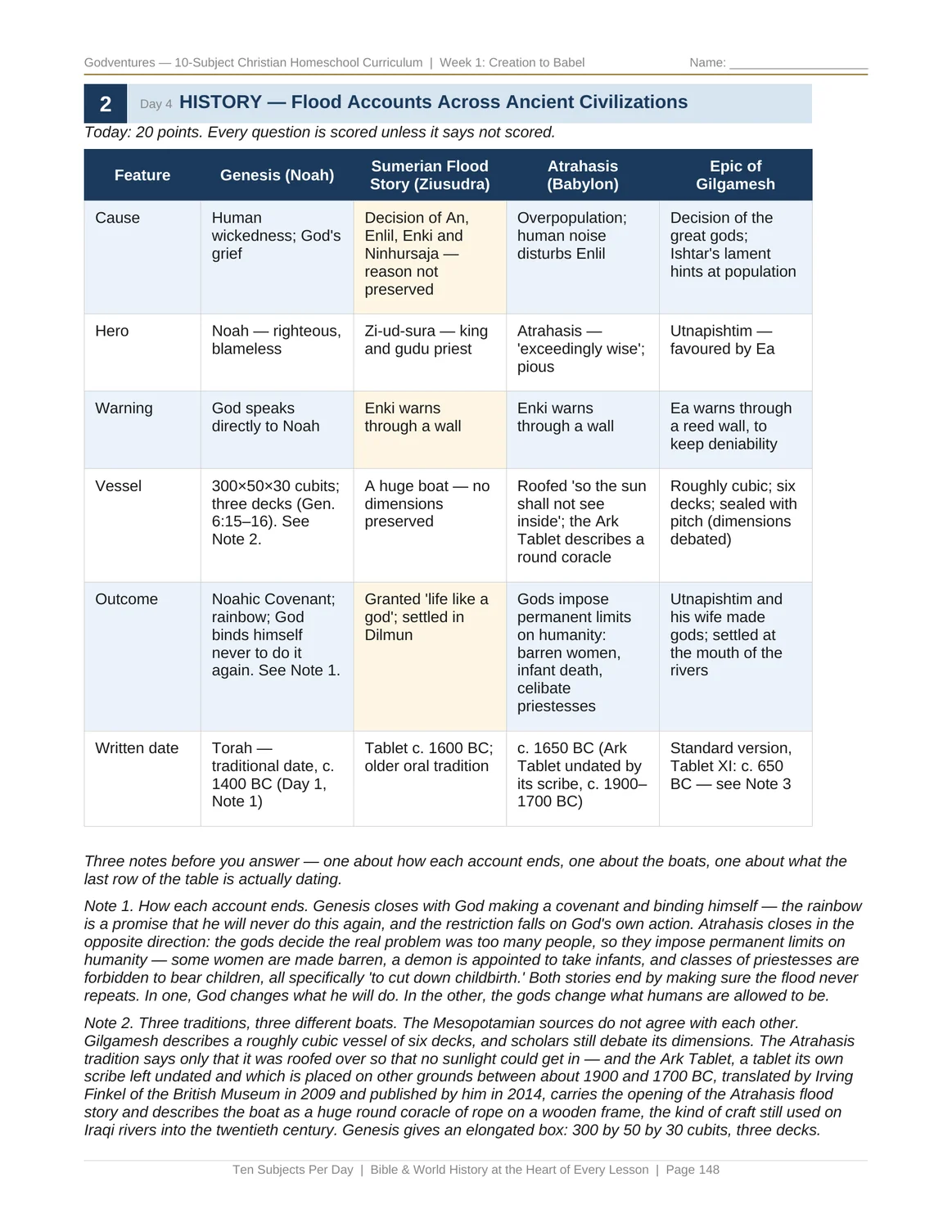
Compare the flood accounts of Genesis, Sumer and Babylon, with notes on how the sources are dated.
Read this sample →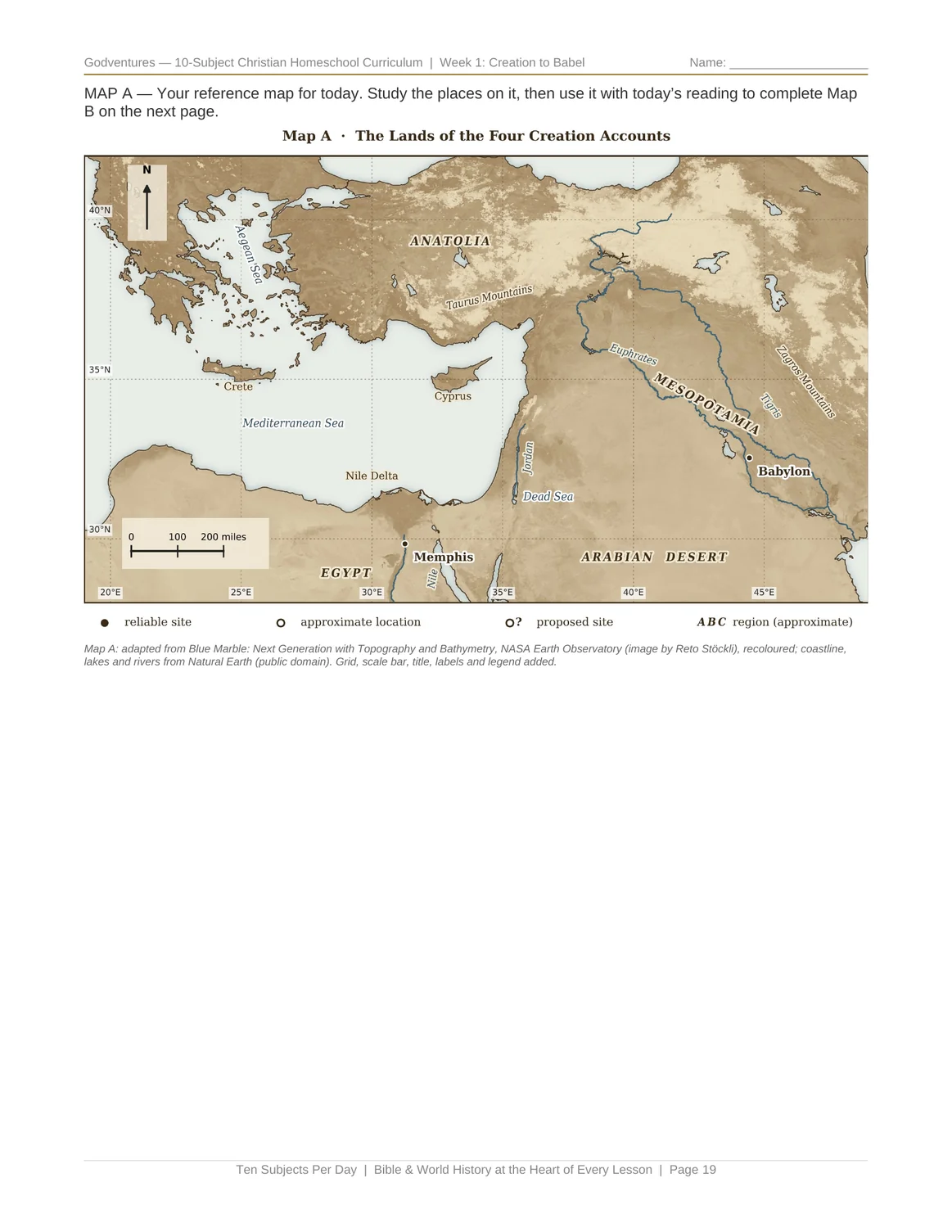
Study the ancient lands and locations introduced in the reading.
Read this sample →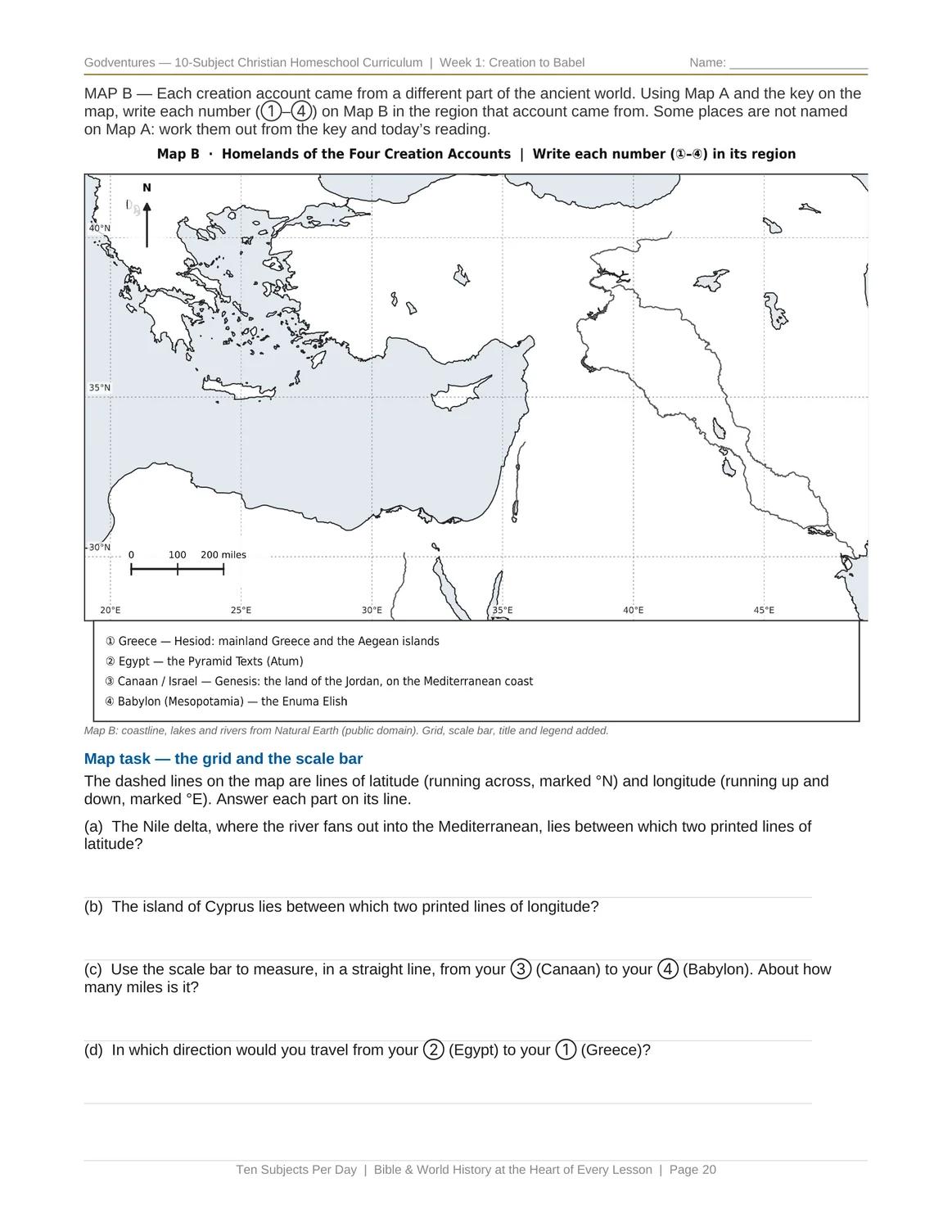
Label regions and use the grid, scale and coordinates.
Read this sample →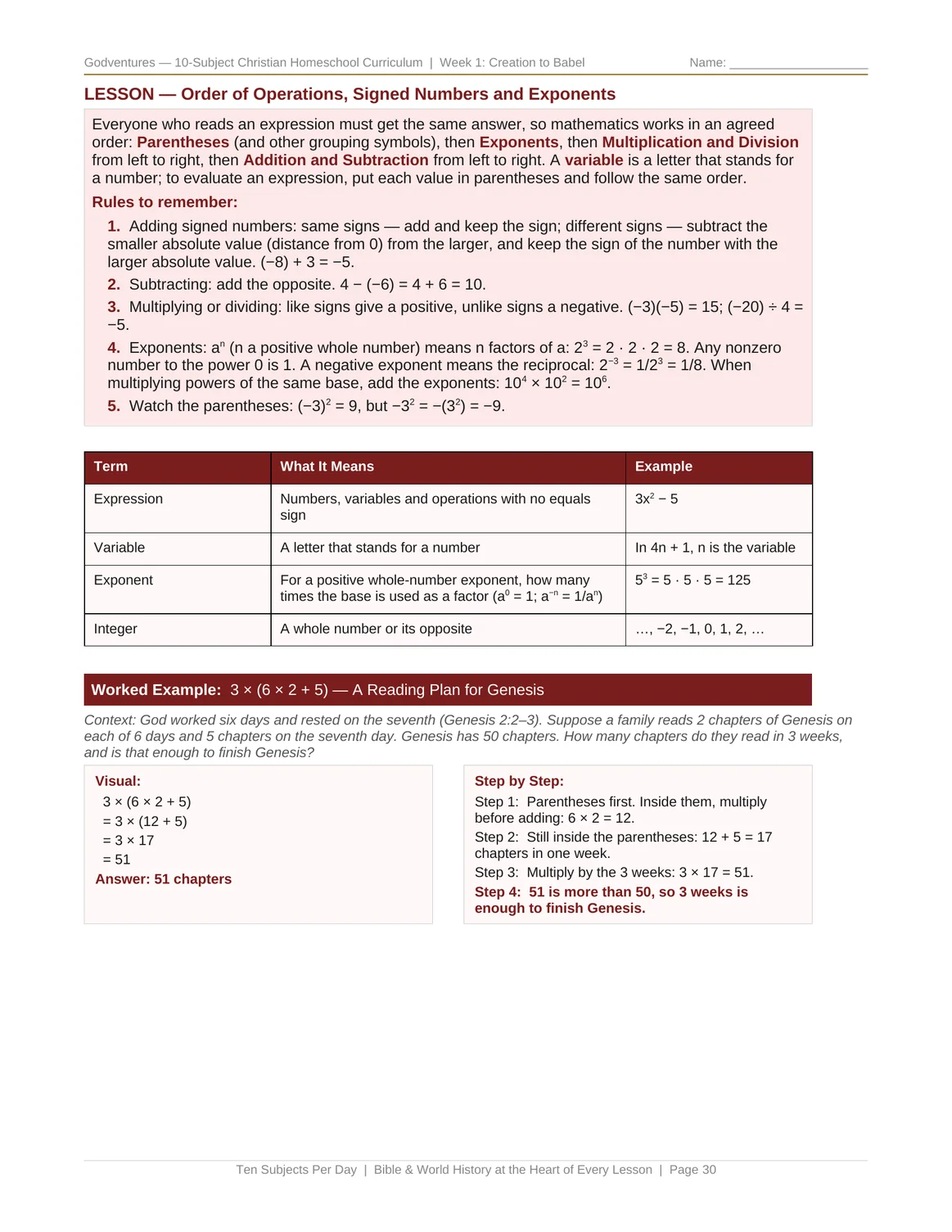
Follow rules, worked examples and a historical word problem.
Read this sample →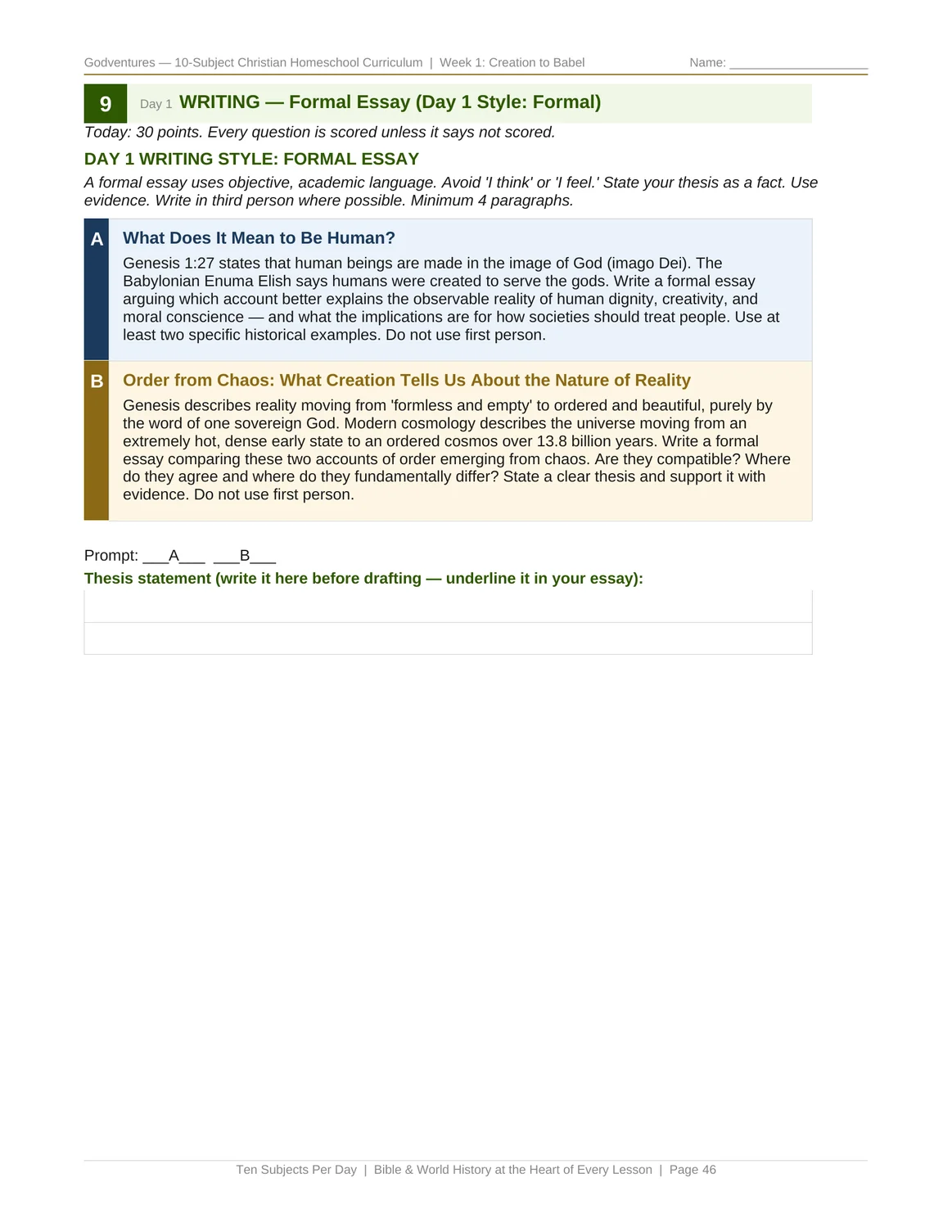
Choose an essay prompt and develop a supported argument.
Read this sample →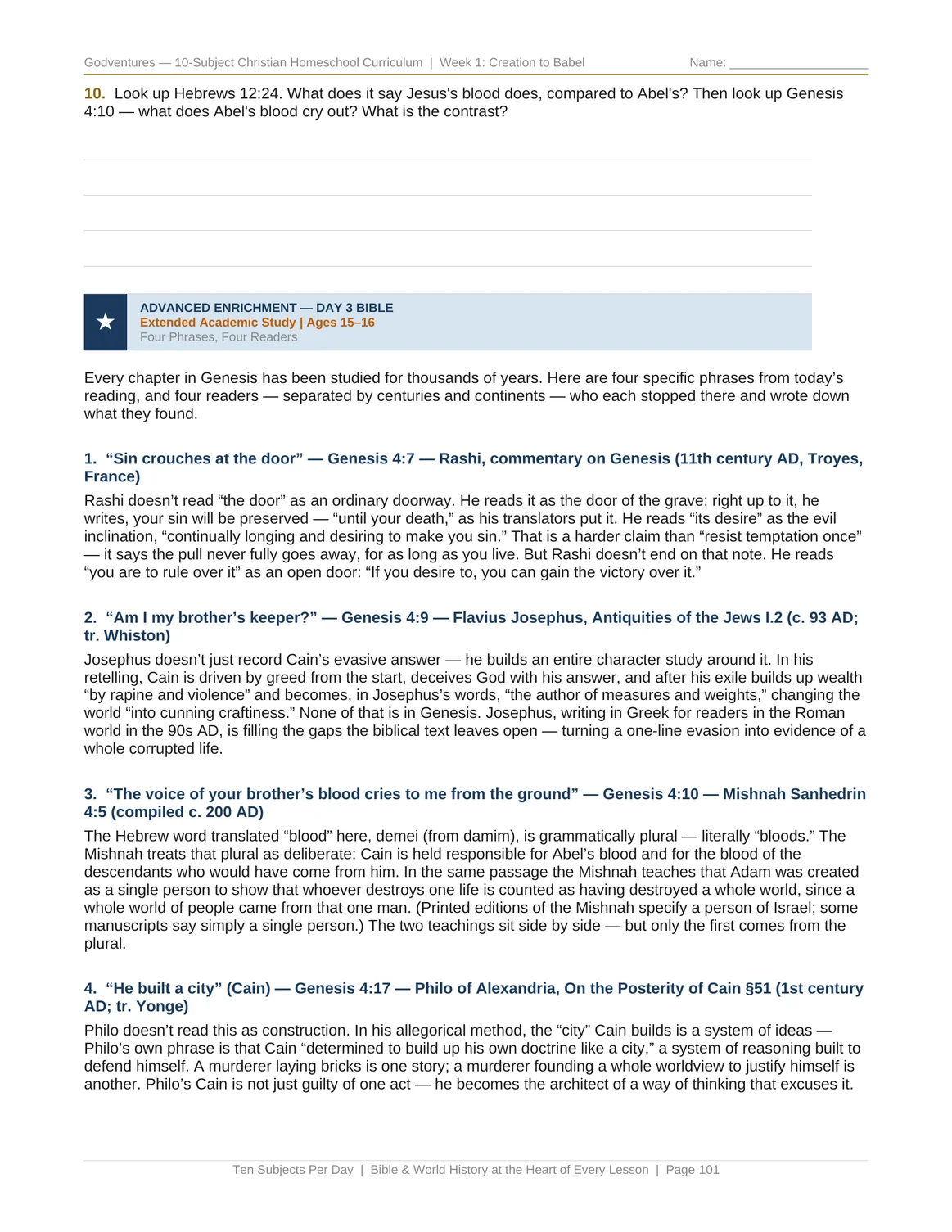
See the deeper interpretation and historical scholarship offered to older students.
Read this sample →All seven previews come directly from the Week 1 student workbook, with pages from Bible, History, Geography, Math, Writing and Advanced Enrichment. The full workbook contains ten subjects each day. The final publication layout may change.
Every planned edition contains the same coursework. The difference is how the pages are printed. No edition is yet available to order.
The most economical planned format: all text, worksheets and maps reproduced in black and white, with a full-color cover.
Price and release date to be confirmed.
Keep color in reference maps, subject headings and illustrations while retaining the same student assignments.
Price and release date to be confirmed.
Our highest-quality color printing, for the richest maps, artwork and subject colors, with the same lessons and activities.
Price and release date to be confirmed.
Choose by budget and color quality—not by academic level. All three are designed to contain the same ten subjects and Advanced Enrichment.
Keep costs downBlack & white paperback
Want color maps?Standard-color paperback
Want the richest color?Premium-color paperback
Purchases will be handled by Amazon. Exact prices, edition links and release dates will be shown when the listings are confirmed. Parent and teacher answer keys are separate publications.
A shared foundation with deeper work for older students. Parents choose assignments with their student’s readiness in mind.
Complete the Core Curriculum across all ten daily subjects. Advanced Enrichment is available when your student is ready for an additional challenge.
Complete the Core Curriculum plus Advanced Enrichment in at least three subjects each day, selected by the parent or teacher. Explore evidence, interpretations and more demanding applications.
Parents may adapt individual assignments to the student’s readiness and educational needs.
The accompanying answer material includes worked solutions, model answers, completed maps and guidance for open-ended work. Core assignments and Advanced Enrichment are evaluated separately.
Explore the answer keys →Start with the samples, then choose the edition that suits your family.
Week 1 covers five school days, with ten subjects each day and Advanced Enrichment for deeper study. Each later week is planned as its own student workbook.
The parent and teacher answer key is sold separately. It includes worked solutions, model responses, completed maps and grading guidance for core and advanced work. Multiweek volume groupings are being finalized.
All students complete the Core Curriculum. Advanced Enrichment is optional for ages 13–14 and part of the standard course for ages 15–16 in at least three subjects each day. Parents select subjects and adjust individual assignments to the student’s readiness.
Yes. All three are intended to contain the same lessons, exercises and enrichment. All three are paperbacks; they differ only in how the interior is printed.
Direct Amazon links will appear beside each edition when its listing is confirmed. You can read the Week 1 sample pages here in the meantime.